04 Nov 2026
Custom SoftwareUAE Vibe Codes: What the AI Coding Initiative Means for Custom Software in Dubai Businesses
UAE Vibe Codes, launched 29 October 2026 with Microsoft, lets anyone turn natural-language ideas into website and app prototypes in minutes. Over 200,000 people engaged and 90,000 platforms were created. For Dubai companies the useful distinction is prototype vs production system that must handle UAE VAT, PDPL, Arabic, and live CRM or ERP data.
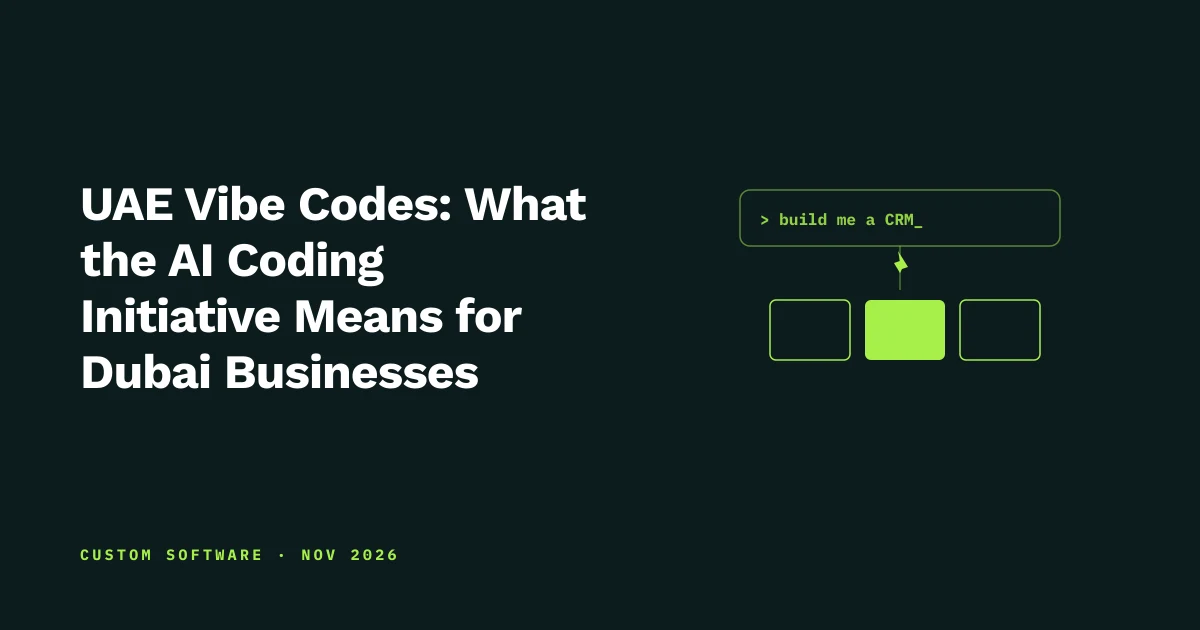
On 29 October 2026, as part of UAE Codes Day, the UAE Artificial Intelligence Office launched UAE Vibe Codes in collaboration with Microsoft. The initiative lets anyone describe an idea in ordinary language and receive a working prototype of a website or digital application within minutes, without prior programming experience. Official figures show 5,000 participants in the first hour, more than 200,000 people engaged overall, and over 90,000 digital platforms created, with participation from more than 65 government and private entities.
The platform is available at uaecodesday.specnt.com. Workshops ran with partners including Google, Emirates Global Aluminium, IBM and Siemens. The stated aim is to lower the barrier to digital creation for students, educators, entrepreneurs, business owners and employees across public and private sectors.
What vibe coding actually produces
Participants describe the desired outcome (a simple internal tool, a landing page, a basic task organiser). AI tools generate the initial structure and interface. The result is a prototype that can be tested, refined and, in many cases, downloaded or continued outside the lab. It is intentionally lightweight: no multi-user authentication, no live database of customer orders, no connection to an existing ERP, and no built-in handling of UAE-specific requirements such as VAT invoice formats, PDPL consent records, or right-to-left Arabic layouts that survive production traffic.
That is useful. A clinic manager or a distributor’s operations lead can now sketch a process idea in an afternoon instead of waiting for a developer quote. Many of the 90,000 platforms are exactly that: exploratory artefacts.
Where the prototype ends and production software begins
Most UAE businesses that move from idea to daily use hit the same four constraints:
- Data and systems already exist. Stock lives in an ERP, patient appointments in a clinic system, order history in a CRM. A prototype does not read or write those records safely.
- Compliance is not optional. PDPL consent, FTA e-invoicing fields (especially after Guidelines v2.0 and the 1 January 2027 Phase 1 go-live), and audit trails must be correct from the first real transaction.
- Language and dialect matter. Gulf Arabic mixed with English, formal vs informal tone, and proper RTL layout are expected by customers. Generic AI output frequently fails both.
- Reliability and ownership. Production systems need monitoring, role-based access, backups, and clear IP ownership. A lab prototype rarely provides any of these.
These are the points at which companies in Dubai, Abu Dhabi and Sharjah move from “we generated a page” to a scoped custom software project. The custom work is usually narrower than a full rebuild: an authenticated front-end that talks to the existing database, a WhatsApp agent that can check live stock, or an extension that maps the fields an Accredited Service Provider expects for e-invoicing.
Practical next steps for teams that tried Vibe Codes
- Keep the prototype as the specification. The language that described the idea is often clearer than a traditional requirements document.
- List the live systems the finished tool must touch (ERP, CRM, WhatsApp Business number, payment gateway).
- Decide the compliance surface: which records are personal data under PDPL, which invoices fall under the Electronic Invoicing System, and who owns the audit log.
- Scope a short technical review rather than another free prototype. Most of the remaining work is integration and guardrails, not the initial interface.
Related reading on Solinify:
- UAE AI adoption: chatbot vs custom agents
- First agentic workflow for UAE SMEs
- Custom software development
- WhatsApp CRM and AI agents
Vibe Codes expands who can start a digital idea. Turning that idea into a system that handles real UAE customer data, invoices and WhatsApp conversations still requires the same engineering decisions that existed before 29 October. A short mapping of the prototype against the systems you already run usually shows the exact scope.
Frequently Asked Questions
Continue Learning
Deeper guides on the topics covered in this article.
Related Articles
Why 9-Second WhatsApp Response Times Close More Deals (AI Agents Explained)
Every WhatsApp Enquiry Is a Sales Opportunity — Here's How AI Captures It
Ready to build your next big thing?
Solinify Tech Studio specializes in building, launching, and scaling AI-powered products and startups. Let's turn your vision into a future-ready business.
Learn About Venture Studio→