06 Nov 2026
ERP & EnterpriseUAE E-Invoicing Phase 2 for SMEs Under AED 50 Million: Prep Checklist Before March 2027
The 30 October 2026 ASP deadline has passed for larger firms. Businesses below AED 50 million revenue have until 31 March 2027 to appoint an Accredited Service Provider and must go live by 1 July 2027. Here is the practical data and system checklist SMEs can start now.
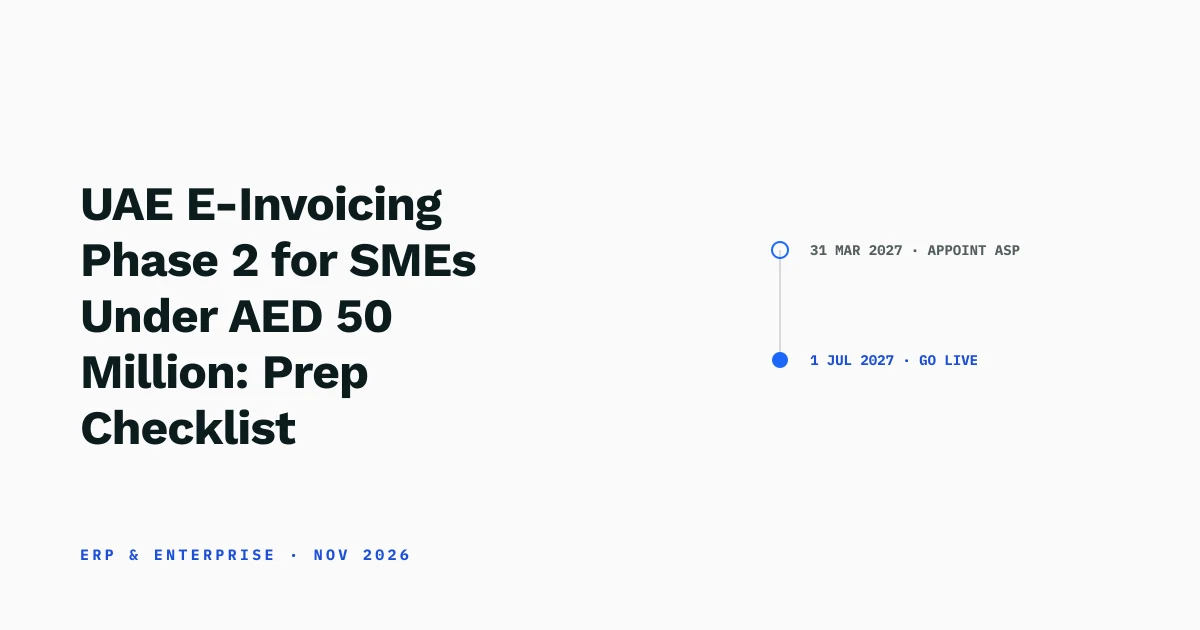
The Accredited Service Provider (ASP) appointment deadline of 30 October 2026 applied to businesses with revenue of AED 50 million or more. Those firms must implement the Electronic Invoicing System by 1 January 2027. For companies below that threshold the timeline is later but still fixed: appoint an ASP by 31 March 2027 and go live on 1 July 2027. Government entities follow a similar appointment date with a 1 October 2027 go-live.
Ministerial Decision No. 197 of 2026 (effective 1 October 2026) temporarily excludes transactions between members of the same VAT tax group from mandatory e-invoicing from 1 January 2027 to 31 December 2028 and removed the previous requirement to store e-invoice data inside the UAE. Version 2.0 of the Electronic Invoicing Guidelines (26 October 2026) added clarifications on taxpayer and buyer identification, advance payments, healthcare and insurance transactions, and onboarding for newly established businesses. None of these changes moved the Phase 2 dates.
What “in scope” means for most SMEs
The system covers B2B and B2G transactions for persons conducting business in the UAE (including many free-zone companies). B2C remains out of scope until a further decision. Newly established businesses in scope must appoint an ASP and complete onboarding before they issue their first invoice. A normal PDF invoice sent by email does not meet the structured data requirement; the invoice must be capable of electronic exchange through the Peppol-based system via an ASP.
Practical checklist SMEs can start now
- Confirm your phase. Use the most recent accounting period revenue (financial statements or accepted documentation). The test is per entity, not consolidated group figures. If you are near the AED 50 million line, confirm with your adviser or the FTA rather than assume Phase 2.
- Map tax-group flows. Identify any intra-group transactions. These are excluded from the mandatory system until 31 December 2028 under Decision 197. External invoices still follow your phase.
- Clean master data. Customer legal names, TRN or TIN, item codes, units, and tax categories must match what an ASP expects. Version 2.0 guidelines distinguish VAT-registered sellers (15-digit TRN) from others (10-digit TIN). Poor master data is the most common reason mapping projects slip.
- Identify the source system. Most SMEs will need the accounting or ERP system (Odoo, Zoho Books, QuickBooks, Tally, custom) to produce the fields the ASP requires. If the system cannot export clean structured data, the mapping or light customisation work should start before the ASP is appointed.
- Review retention and access. Data may now be stored outside the UAE, but the person remains responsible for keeping records and producing them to the FTA on request. Confirm your ASP’s retention and access terms.
- Shortlist ASPs and plan onboarding. Accreditation rules were updated under Ministerial Decision No. 168 of 2026. New businesses must complete onboarding before their first invoice. Factor the time for testing and any required system changes.
- Penalties awareness. Cabinet Decision No. 173 of 2026 replaced the earlier penalty decision. Administrative penalties for failure to implement apply from the mandatory date (initial AED 5,000 and further amounts for continuing failure in some summaries). Voluntary adoption before your mandatory date is generally not penalised.
Where custom software or light integration helps
If your current accounting system already holds clean customer and item data, the work is usually configuration and mapping with the ASP. If invoices are assembled in spreadsheets, WhatsApp voice notes or a custom front-end that does not write structured records, the e-invoicing project becomes a data-cleanup and integration project. That is the same surface we see when building order-to-cash or WhatsApp-to-ERP flows for distributors and clinics.
Related reading on Solinify:
- E-invoicing after the 30 October ASP deadline
- Ministerial Decision 197 details
- AI agents and e-invoicing data cleanup
- Custom software cost ranges in Dubai 2026
- Custom software development
- Revenue OS for distributors (order-to-ERP)
Phase 2 is later than Phase 1, but the useful work—clean master data, knowing which system produces the invoice fields, and mapping tax-group exclusions—can start now. Waiting until the March 2027 ASP deadline compresses testing and increases the chance of errors on the 1 July 2027 go-live date.
Related Articles
Why 9-Second WhatsApp Response Times Close More Deals (AI Agents Explained)

Every WhatsApp Enquiry Is a Sales Opportunity — Here's How AI Captures It
Ready to build your next big thing?
Solinify Tech Studio specializes in building, launching, and scaling AI-powered products and startups. Let's turn your vision into a future-ready business.
Learn About Venture Studio→