05 Nov 2026
Custom SoftwareCustom Software Development Cost in Dubai and the UAE in 2026: Realistic Ranges
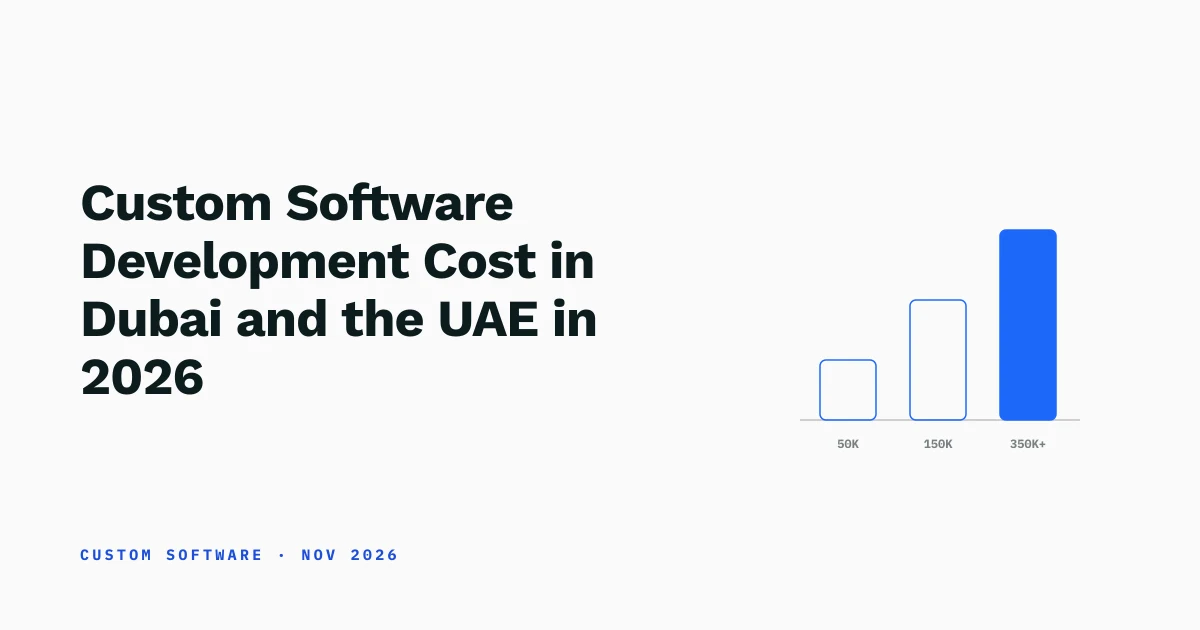
Indicative 2026 ranges for custom software in Dubai: narrow prototypes from roughly AED 50,000, production MVPs AED 150,000–350,000, and platforms with integrations and compliance from AED 350,000 upward. The drivers that move the number are Arabic, live system connections, PDPL and e-invoicing fields, and whether the software is the product.
Search results for “custom software development cost Dubai” or “software development cost UAE 2026” are full of wide ranges. Some start at AED 25,000 for a simple internal tool; others quote AED 2 million or more for enterprise platforms. Both can be true. The useful question is which band applies to the job you actually need done, and which UAE-specific factors move the number.
The figures below are indicative ranges drawn from publicly discussed 2026 project bands across Dubai agencies and delivery models. They are not Solinify quotes. A short discovery on your actual systems, data quality and compliance surface is the only reliable way to price a specific project. All figures exclude 5% VAT.
Indicative ranges by project type (2026)
- Narrow prototype or single-workflow internal tool — roughly AED 50,000 to AED 150,000, 6–12 weeks. One process, limited users, few or no external integrations.
- Production MVP or business application — roughly AED 150,000 to AED 350,000, 3–6 months. User roles, basic reporting, one or two integrations (CRM, payment, WhatsApp), bilingual interface.
- Growth platform with multiple integrations — roughly AED 350,000 to AED 900,000. Connections to ERP/CRM/POS, mobile or customer portal, stronger access control, and the fields required for PDPL or the Electronic Invoicing System.
- Enterprise or regulated platform — AED 900,000 to several million. Multi-entity logic, high-volume data, custom AI agents that act on live records, sovereign or private hosting requirements, and ongoing operational support.
What moves the cost in the UAE
Four factors appear repeatedly in real project scopes:
- Arabic and dialect. Proper right-to-left layout, Gulf Arabic mixed with English, and tone that matches the customer base add design and testing time. Generic English-first output usually needs rework.
- Live system connections. Reading or writing an existing ERP, clinic system, or CRM is rarely a simple API call. Data quality, field mapping, and error handling dominate the effort. This is also where most e-invoicing readiness work sits: the fields an Accredited Service Provider expects must match the records the business already keeps.
- Compliance surface. PDPL consent and retention, FTA e-invoicing (Phase 1 go-live 1 January 2027 for revenue of AED 50 million or more; Phase 2 later for smaller firms), sector rules (healthcare, financial, VARA for virtual assets). These are not optional add-ons once the system handles real transactions.
- Whether the software is the product. An internal tool that replaces spreadsheets has a different risk profile from a customer-facing platform that generates revenue. The latter usually needs stronger monitoring, role design, and ownership clarity.
Build, customise or buy
Off-the-shelf SaaS or an ERP module is faster when the process is standard and differentiation lives elsewhere. Custom work is justified when the workflow is the competitive edge, when existing systems must be extended rather than replaced, or when the agent or portal must read live records the packaged tool cannot reach. Many projects sit in the middle: a narrow custom front-end or WhatsApp agent that talks to the system the company already runs.
How to get a comparable quote
Ask any vendor (including us) for:
- The exact systems the software must read or write.
- Which records are personal data under PDPL and which invoices fall under the Electronic Invoicing System.
- The language and dialect expectations for customer-facing screens or agents.
- What is excluded (native mobile apps, ongoing support, data migration, third-party licences).
A two-to-four-week discovery that produces a written scope and a range is usually cheaper than restarting after an underscoped build.
Related reading on Solinify:
- E-invoicing after the 30 October ASP deadline
- Vibe Codes vs production custom software
- Custom software development
- First agentic workflow
In 2026 the market for custom software in Dubai is not one price. It is a set of ranges driven by how many live systems the new software must touch, how much Arabic and compliance work is required, and whether the result is an internal tool or a revenue system. Mapping those three points usually narrows the band before any detailed design starts.
Frequently Asked Questions
Continue Learning
Deeper guides on the topics covered in this article.
Related Articles
Why 9-Second WhatsApp Response Times Close More Deals (AI Agents Explained)

Every WhatsApp Enquiry Is a Sales Opportunity — Here's How AI Captures It
Ready to build your next big thing?
Solinify Tech Studio specializes in building, launching, and scaling AI-powered products and startups. Let's turn your vision into a future-ready business.
Learn About Venture Studio→